
Smart Utilities8 min read
The Evening Ramp Is a Revenue Line: Making ToD Tariffs Real in an Indian DISCOM

Randhir Kumar Verma, PMP®
Published 27 Sept 2026
The Evening Ramp Is a Revenue Line: Making ToD Tariffs Real in an Indian DISCOM
Executive Summary
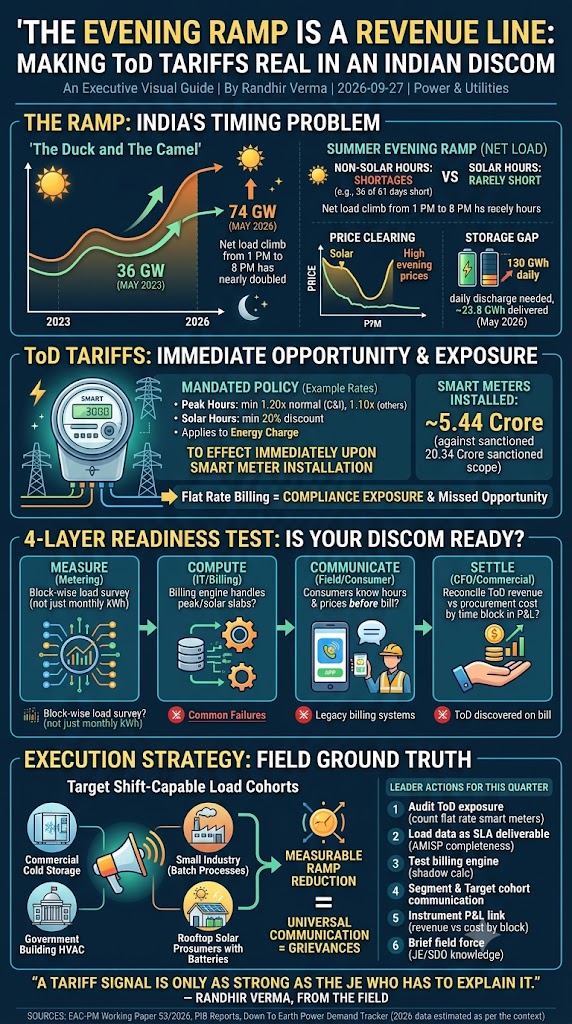
India solved its generation problem and inherited a timing problem. The Economic Advisory Council to the Prime Minister put a number on it in July 2026: the summer evening ramp — the net load climb from 1 PM to 8 PM — grew from roughly 36 GW in May 2023 to about 74 GW in May 2026. That is a doubling in three years.
Time of Day tariffs are the cheapest instrument we have against that ramp. They are already notified under the Electricity (Rights of Consumers) Rules. Yet in most DISCOMs, ToD exists as a clause in a tariff order and nowhere else. The consumer does not feel it. The meter reads it but nobody acts on it. The SDO cannot explain it.
My argument is narrow. ToD is not a tariff reform. It is a data-pipeline and field-communication programme that happens to be priced. Treat it as a tariff exercise and it will produce a rounding error. Treat it as an execution programme and it becomes the first demand-side lever a DISCOM has ever actually owned.
The Curve Changed Shape Before Our Systems Did
The EAC-PM working paper The Duck and The Camel makes an observation that should reorganise how a distribution CXO thinks about risk. During May 2026, the grid fell short of meeting solar-hour peak demand on only 6 of 61 days. In non-solar hours it fell short on 36 of 61. Scarcity has moved to a four-hour window after sunset.
Price followed. Solar-hour market clearing collapsed from ₹2.81/kWh in May 2023 to ₹1.11/kWh in May 2026. Meanwhile the same paper estimates that halving the evening ramp would need roughly 130 GWh of daily discharge, against a storage fleet delivering about 23.8 GWh a day in May 2026.
Read those three facts together. Cheap power sits in the middle of the day. Expensive power sits in the evening. Storage will not close the gap this decade. The residual instrument is consumer behaviour — and the only way to reach consumer behaviour at scale is the meter.
India's all-time peak of 270.8 GW on 21 May 2026 makes the same point from the other side. Renewables carried 34% of that peak, and the system's shortage during non-solar hours was 2.57 GW against just 0.18 GW in solar hours. The grid is not short of energy. It is short of energy at 8 PM.
ToD Is Already Law — and Already Stranded
The rules are unambiguous. Peak-hour tariffs must be at least 1.20 times the normal tariff for commercial and industrial consumers above 10 kW, and at least 1.10 times for other categories. Solar-hour tariffs must be at least 20% below normal. ToD applies to the energy charge, not to fixed or demand charges. For consumers with smart meters, it takes effect immediately on installation.
That last clause is where the programme lives or dies. As of mid-January 2026, about 4.05 crore consumer meters had been installed under RDSS — 5.44 crore across all schemes — against a sanctioned scope of 20.34 crore meters, DTs and feeders. So roughly one consumer in five can even receive a time-differentiated price.
Two consequences follow, and neither is discussed enough in review meetings.
First, the DISCOM carries the full cost of the evening ramp while the price signal reaches only a minority of its load. The subsidy of flat tariffs is now a subsidy of bad timing.
Second, and more uncomfortable: where smart meters are installed, ToD is legally live whether or not the utility has built for it. A consumer billed on a flat rate after smart meter installation is a compliance exposure, not just a missed opportunity.
A Four-Layer Readiness Test
I use this framework with AMISPs and IT teams because it forces the conversation past "the meter is installed."
| Layer | The question to ask | Common failure mode | Accountable owner |
|---|---|---|---|
| Measure | Are we capturing and retaining block-wise load survey data, not just monthly kWh? | HES pulls billing registers only; load profile discarded or unread | AMISP + Head, Metering |
| Compute | Can the billing engine apply peak, normal and solar-hour slabs per consumer per cycle? | Legacy billing does one energy rate; ToD handled by manual workaround | Head, IT / Billing |
| Communicate | Does the consumer know which hours cost more, in their language, before the bill? | ToD discovered on the bill; grievance volume spikes at the SDO office | SDO + Commercial |
| Settle | Can we reconcile ToD revenue against actual procurement cost by time block? | Benefit assumed in the tariff filing, never proven in the P&L | CFO + Commercial |
Most DISCOMs pass Measure, fail Compute, ignore Communicate, and have never attempted Settle. The order matters: communication failure at layer three creates political pressure that kills the tariff at layer one, no matter how good the engineering was.
What Ground Truth Looks Like in North Bihar
In our terrain, the ToD conversation is not about price elasticity curves. It is about a JE who will be asked, in person, why the bill went up in June. It is about a shopkeeper whose load is fixed by shop hours and cannot shift. It is about an agricultural feeder that is out of scope entirely.
So the honest design question is: who in my consumer mix can actually shift load? The answer is a short list — commercial cold storage, small industry with batch processes, institutional water pumping, government building HVAC, and rooftop solar prosumers sizing a battery. That list is small in count and large in kWh. It is where the first ToD campaign belongs.
Attempting universal ToD communication in year one buys grievances. Attempting it with 2,000 high-consumption, shift-capable consumers buys a measurable ramp reduction and a defensible number for the next tariff petition.
What This Means for Leaders
- Audit ToD exposure this quarter. Count consumers with commissioned smart meters who are still billed on a flat energy rate. That number is your compliance and revenue gap, and nobody currently owns it.
- Make load survey data a contractual deliverable, not a feature. Write block-wise profile availability and completeness percentages into the AMISP SLA, with penalties. Without the profile, nothing downstream is possible.
- Test the billing engine before the tariff order, not after. Run a shadow ToD calculation on one division for two cycles. Compare against flat billing. Fix the arithmetic where it is cheap to fix.
- Segment before you communicate. Identify the shift-capable cohort by load profile, then run SMS, bill-insert and SDO-led outreach to that cohort only. Measure ramp response, not satisfaction scores.
- Instrument the P&L link. Ask the CFO for one page each month: ToD revenue by block against power purchase cost by block. If that page cannot be produced, the programme is not real yet.
- Brief the field before the consumer. Every JE and SDO in the pilot division should be able to state the peak window and the solar-hour discount from memory. The bill should confirm what they already said.
Key Takeaways
- India's scarcity has moved from energy to timing: the summer evening ramp roughly doubled to about 74 GW between May 2023 and May 2026.
- Storage will not carry this decade's ramp — roughly 130 GWh of daily discharge is needed against about 23.8 GWh delivered.
- ToD is already notified: at least 1.20x peak for large C&I, 1.10x for others, at least 20% off in solar hours, on the energy charge.
- Only about one in five sanctioned meters is installed, so most load cannot yet receive a time signal — and where meters exist, flat billing is an exposure.
- Sequence the work Measure → Compute → Communicate → Settle, and start with the small cohort that can actually shift load.
Written from the field, where a tariff signal is only as strong as the JE who has to explain it.
Sources: EAC-PM Working Paper 53/2026, The Duck and The Camel: Tracing the Net Load on the Indian Power Grid (July 2026) · PIB, Progress on Smart Meter Installation under RDSS (2 February 2026) · PIB, Implementation of Time of Day Electricity Tariff System · Down To Earth, Power Demand Tracker: India meets all-time high demand of 270.8 GW
Enjoyed this? Get the next one by email
Occasional notes on smart metering, AMI and AI in utilities. No spam; unsubscribe in one click.
Related articles
Comments
No comments yet. Be the first to share a thought.