
Smart Utilities8 min read
The 26-Gigawatt Customer: What India's DISCOMs Must Fix Before AI Load Arrives

Randhir Kumar Verma, PMP®
Published 28 Sept 2026
The 26-Gigawatt Customer: What India's DISCOMs Must Fix Before AI Load Arrives
Executive Summary
Every conversation I have about AI in the Indian power sector starts with models and ends with dashboards. That is the wrong end of the problem. The largest, fastest and most consequential AI event for a DISCOM is not a forecasting algorithm. It is a customer.
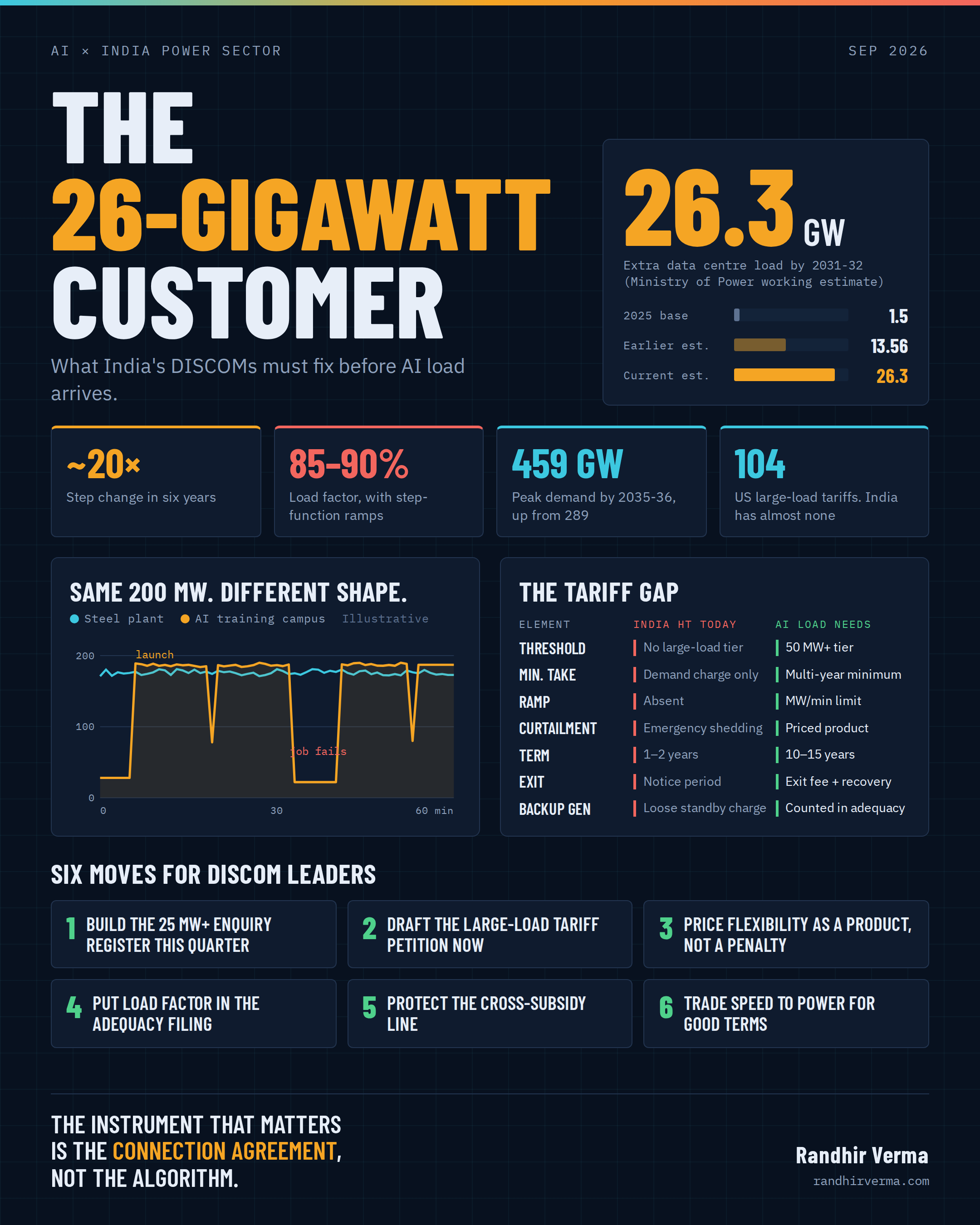
The Ministry of Power's working estimate for additional data centre load in India has moved to 26.3 GW by 2031-32, roughly double an earlier estimate of 13.56 GW. Against installed data centre capacity of about 1.5 GW in 2025, that is a twenty-fold step change inside six years. For context, the Central Electricity Authority projects national peak demand rising from 289 GW in 2026-27 to 459 GW by 2035-36. Data centres are not a rounding error in that curve. They are a visible share of it, concentrated in a handful of states and a handful of substations.
My argument is simple. This load is not merely large. It is shaped differently from anything a distribution utility has served before, and our commercial architecture — tariff orders, connection agreements, resource adequacy filings — has not caught up. The utilities that write the right contract in the next eighteen months will capture high-load-factor revenue at low incremental cost. The ones that do not will socialise someone else's ramp across their agricultural and domestic consumers.
The Load Is Not Big. It Is Shaped Wrong.
A 200 MW steel plant is predictable. It signs a contract demand, runs a stable process, and its deviations are measured in single-digit percentages. A 200 MW AI training campus is a different animal. Synchronised GPU clusters move from idle to near-full draw in seconds when a job launches, and collapse just as fast when it checkpoints or fails.
The Grid Controller of India has flagged exactly this, warning that the "variable and highly spiky nature of data centre loads, along with sharp ramps, could pose risks to grid stability." That is not a distant concern. It is a statement about the frequency response and reserve procurement of a grid that already manages a steep evening solar ramp.
Three consequences follow, and each lands on a different desk:
- Planning. Resource adequacy models built on diversified load curves under-provision for a customer with 85-90% load factor and step-function ramps.
- Operations. Sub-transmission assets sized on diversity factors see none of it. One campus can be the whole feeder.
- Commercial. If the connection agreement has no ramp-rate obligation and no curtailment pathway, the utility absorbs the balancing cost and recovers it from everyone else.
CEA has begun directing states and distribution companies to factor projected data centre demand into resource adequacy plans. That is the right instruction. The harder work is the contract underneath it.
The Tariff Gap, Benchmarked
The United States has run ahead of us here, not because its regulators are smarter but because its queue filled first. The number of large-load tariffs tracked across US utilities rose from 41 in July 2025 to 104 by mid-2026, spanning more than 70 utilities across 37 states. Around 45% set the large-load threshold at 50 MW or above, and roughly one quarter now include a concrete dispatchable-flexibility or curtailment pathway.
Set that against standard Indian HT industrial practice and the gap is visible.
| Design element | Typical Indian HT industrial tariff | What an AI-scale load requires |
|---|---|---|
| Threshold class | Generic HT-II / HT-III, no large-load tier | Dedicated tier at 50 MW+ with separate cost allocation |
| Minimum take | Contract demand charge only | Multi-year minimum take, so stranded assets are not socialised |
| Ramp obligation | Absent | Contractual MW/minute limit and notified job-launch windows |
| Curtailment | Emergency load shedding only | Priced, dispatchable curtailment product with defined hours |
| Term | 1-2 year cycles | 10-15 year agreement matched to network asset life |
| Exit | Notice period | Exit fee and network cost recovery on early termination |
| Behind-the-meter generation | Standby charge, loosely enforced | Disclosed backup capacity, counted in adequacy planning |
None of this is anti-investor. India is chasing roughly $200 billion of data centre and AI infrastructure investment by 2030, with capacity projected to reach around 10 GW and consumption 40-45 TWh. Developers want speed to power more than they want a marginal paisa on the tariff. A DISCOM that can offer a credible connection date in exchange for ramp discipline and curtailment rights is trading something cheap for something valuable.
A Readiness Framework for Distribution Leadership
I use a five-part grid when assessing whether a utility is ready for this customer class. It maps cleanly to accountability.
| Dimension | Diagnostic question | Owner |
|---|---|---|
| Visibility | Do we have a single register of every data centre enquiry above 25 MW, with MW, location and expected energisation date? | Commercial / Planning |
| Network | Have we modelled each enquiry against the specific substation and transformer, not the state aggregate? | Transmission planning |
| Contract | Does our standard connection agreement contain ramp, curtailment, minimum-take and exit terms? | Legal / Regulatory |
| Adequacy | Is this load inside our resource adequacy filing with an explicit load-factor assumption? | Regulatory affairs |
| Recovery | Can we demonstrate to the commission that no cross-subsidy leaks from this class to domestic and agricultural consumers? | Finance / CFO |
Most utilities I speak with score well on Visibility and poorly on Contract and Recovery. That is the expensive combination: you know the load is coming, and you have no instrument to manage it.
Why This Matters Even Where No Data Centre Is Being Built
I work with a DISCOM in North Bihar. We will not host a hyperscale campus this decade. It would be a mistake to conclude this is someone else's problem.
Second-order effects reach every utility in the country. National peak demand pulls up merit-order dispatch and short-term market prices, and the states with the thinnest balance sheets buy the most expensive marginal power. Transmission charges get pooled. Round-the-clock renewable contracts signed by data centre developers compete for the same tendered capacity a state utility needs for its own RPO. And engineering talent that could be building AMI analytics gets bid away by campus construction.
The defensive move is not to complain. It is to get our own house in order before the market tightens: firm up long-term PPAs, finish the prepaid and ToD work that flattens our own demand curve, and build the load-research capability that lets us argue our case credibly at the commission. Every unit of flexibility we create at home is a unit we do not have to buy at exchange peak.
What This Means for Leaders
- Build the enquiry register this quarter. One spreadsheet, owned by a named officer, covering every connection enquiry above 25 MW. You cannot plan for a pipeline you have not counted.
- Draft the large-load tariff petition now, not after the first application. Threshold, minimum take, ramp limits, curtailment product, term and exit. File it before a developer's timeline forces a rushed approval.
- Price flexibility as a product, not a penalty. A discount for contracted curtailment hours is easier to sell — and easier to defend before the regulator — than a surcharge for spiky behaviour.
- Put load factor in the adequacy filing explicitly. State the assumed load factor for this class and the ramp profile you have modelled. Undocumented assumptions become audit findings.
- Protect the cross-subsidy line. Show the commission the cost-to-serve calculation for this class. The political risk of appearing to subsidise AI infrastructure is real and worth pre-empting.
- Treat speed to power as your negotiating currency. Your connection date is worth more to a developer than a tariff concession. Trade it for terms that protect your other consumers.
Key Takeaways
- India's data centre load estimate has roughly doubled to 26.3 GW by 2031-32, from about 1.5 GW installed in 2025.
- The risk is not volume alone; it is ramp shape and load factor, which today's HT industrial tariffs do not price.
- US utilities now run 104 tracked large-load tariffs, a quarter of them with explicit curtailment pathways. India has almost none.
- Utilities in non-hub states still absorb second-order costs through market prices, pooled transmission charges and RE competition.
- The instrument that matters is the connection agreement, not the algorithm.
Written from the field in North Bihar, where the next gigawatt of AI load will never be built — and will still show up on our power purchase bill.
Sources: Energetica India — India's AI Data Centre Boom Set to Add 26.3 GW Load (28 Jul 2026) · Mercom India — CEA Projects India's Peak Power Demand to Reach 459 GW by 2035-36 (24 Mar 2026) · DSIRE Insight — Where Large-Load Tariffs Fit in the Future of Data Center Flexibility (1 Sep 2026) · Outlook Business — Data Centre Boom Pushes India to Rethink Power Planning (8 Apr 2026)
Enjoyed this? Get the next one by email
Occasional notes on smart metering, AMI and AI in utilities. No spam; unsubscribe in one click.
Related articles
Comments
No comments yet. Be the first to share a thought.