
Smart Utilities8 min read
Installed Is Not Realised: India's Prepaid Conversion Gap in Smart Metering

Randhir Kumar Verma, PMP®
Published 23 Sept 2026
Installed Is Not Realised: India's Prepaid Conversion Gap in Smart Metering
Executive Summary
I have spent enough years inside smart metering programmes to know which number gets celebrated and which number pays the bills. They are not the same number.
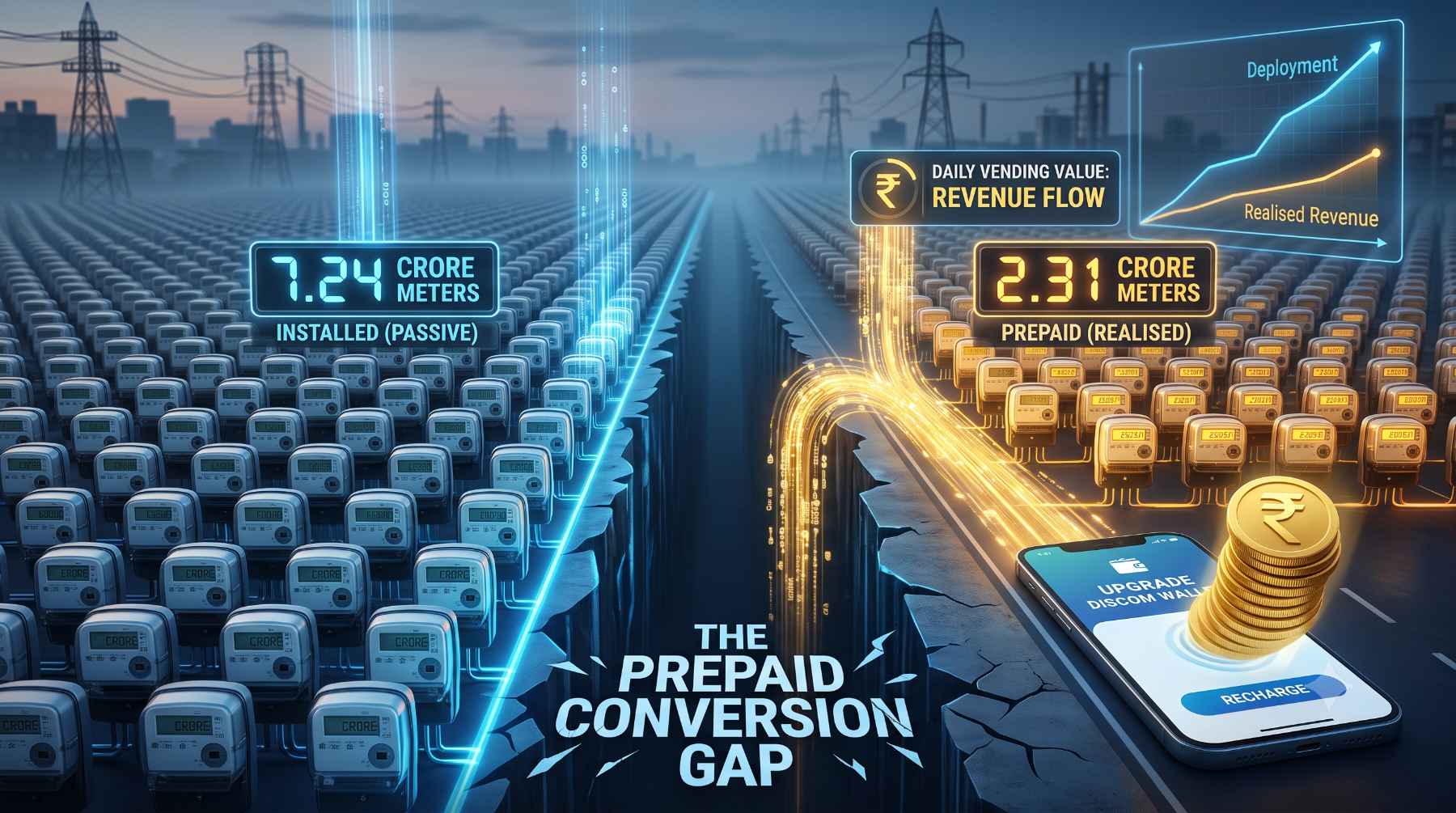
As of 30 June 2026, India had 7.24 crore smart meters installed across consumer, distribution transformer and feeder categories, against 20.33 crore sanctioned under the Revamped Distribution Sector Scheme. That is real progress on a hard rollout. But when the Power Minister placed figures before the Lok Sabha in December 2025, the split was stark: 4.93 crore meters installed, and 1.6 crore functioning in prepaid mode. Roughly one in three.
A meter that is installed but still billed on a monthly postpaid cycle is a capital asset generating a fraction of its business case. The AMISP has been paid. The consumer has been disturbed. The cash conversion cycle has not moved. My argument is simple: the industry's headline KPI is wrong, and until boards start reviewing prepaid conversion and daily vending value instead of meters installed, the sector will keep mistaking deployment for transformation.
The Number That Moved, and the Number That Didn't
Two data points, both from the Government of India, tell the story.
Installation is accelerating. Prepaid conversion is not keeping pace. The reason is structural, not technical. Installation is an AMISP deliverable with a milestone payment attached. Prepaid conversion is a DISCOM deliverable with no milestone, no single owner, and a queue of political, billing and IT dependencies in front of it.
So the contract incentivises the easy half of the job.
The financial stakes are not abstract. In FY25, distribution utilities collectively posted a profit of ₹2,701 crore against a loss of ₹25,553 crore in FY24. AT&C losses came down to 15.04 per cent and the ACS-ARR gap narrowed to ₹0.06 per unit. That is a remarkable turnaround — and also a razor-thin one. Six paise a unit is not a cushion. It is a rounding error that one bad recovery quarter erases.
Prepaid conversion is the single lever that protects that margin, because it moves revenue from recovered after consumption to collected before consumption.
The Meter-to-Money Chain
In my reviews I stopped asking "how many meters did we install this month". I ask where each meter sits on a five-stage chain. Every stage has a different failure mode and a different owner, and revenue only exists at the end.
| Stage | What "done" means | Typical failure | Owner | KPI to review weekly |
|---|---|---|---|---|
| 1. Installed | Meter physically fitted, photographed, geo-tagged | Wrong consumer indexing at site | AMISP field team | Installation-to-index match % |
| 2. Communicating | Meter sends data to HES on schedule | RF/cellular dead zones, NIC failures | AMISP + telecom partner | Daily read success % |
| 3. Reconciled | Meter maps to the correct CRM/billing account and tariff | Duplicate or orphan consumer IDs | DISCOM IT + revenue cell | Unmapped meter count |
| 4. Converted | Account flipped to prepaid, opening balance seeded | Arrears dispute, no instalment policy | DISCOM commercial + SDO | Prepaid conversion % of installed |
| 5. Vending | Consumer recharges; auto-disconnect enabled | Recharge channel friction, disconnect kept off | Revenue + customer ops | Daily vending value, ₹/meter/month |
Most programmes are audited at stage 1 and reported at stage 1. The cash sits at stage 5. Between the two, a meter can be lost to a mismatched consumer index, a feeder with no signal, or an arrears balance nobody has authority to restructure.
Stage 4 deserves a special mention. The technical work of flipping a meter to prepaid takes minutes. The organisational work — deciding what happens to a consumer carrying two years of disputed arrears — takes months, and it is a policy decision, not an IT ticket. Programmes that publish a written arrears-settlement rule before conversion begins move three to four times faster through this stage than those that handle it case by case.
The Denominator Problem
There is a second issue that should trouble anyone running a data-driven utility: we do not agree on what we are counting.
A Ministry statement in December 2025 put installations at 4.93 crore. A Press Information Bureau release in February 2026 reported 3.90 crore under RDSS and 5.28 crore across all schemes as of 31 December 2025. The August 2026 parliamentary figure of 7.24 crore explicitly bundles consumer, DT and feeder meters together. These are not contradictions — they are different denominators. But when a sector reports three defensible versions of the same month, no board can benchmark performance and no lender can price risk.
The same fragmentation shows up in the technology stack. Power Secretary Pankaj Agarwal said in December 2025 that "there should not be any locking between any manufacturer and any protocol." He is right, and the consequence is under-appreciated: a DISCOM with four AMISPs running four head-end systems has four versions of consumer truth, and each prepaid conversion has to be reconciled four different ways. Interoperability is not a procurement nicety. It is the precondition for a single conversion pipeline.
What Bihar Proved, and What It Costs to Copy
Bihar is the counter-example worth studying. An independent review of the national rollout found that Bihar had awarded all sanctioned meters, had 78 per cent of installed meters communicating, and — the part that matters — had all of them in prepaid mode.
That did not happen because Bihar had better meters. It happened because the state treated prepaid as the default operating mode from day one rather than a later migration, and because field staff at SDO and JE level were made accountable for conversion, not just for installation support. When the sub-division that answers for revenue also answers for conversion, the chain closes.
The cost of copying this is not capital. It is governance: a written arrears policy, one reconciled consumer master, and a monthly review where the AMISP and the DISCOM revenue cell sit at the same table with the same dashboard.
What This Means for Leaders
- Change the headline KPI this quarter. Replace "meters installed" with "prepaid meters vending in the last 30 days" as the board-level number. Everything else is a sub-metric.
- Publish an arrears-settlement rule before you convert. One page, uniform across the circle, with an instalment ladder. Ambiguity here is the largest single cause of stalled conversion.
- Put stage-3 reconciliation on the critical path. Fund a dedicated consumer-master cleanup team before the next tranche of installations, not after. Unmapped meters compound.
- Write conversion into the AMISP contract. Tie a defined share of the monthly service fee to meters that are communicating and converted, not merely installed.
- Insist on protocol neutrality in every new tender. Specify open, interoperable data exchange with the head-end so that a vendor change never becomes a data migration project.
- Give the SDO a daily vending number. Field ownership follows measurement. If the sub-division sees ₹ per meter per day, behaviour changes within one billing cycle.
Key Takeaways
- India has 7.24 crore smart meters installed (June 2026) against 20.33 crore sanctioned — but only about a third of installed meters were in prepaid mode as of December 2025.
- Installation is contractually incentivised; conversion is not. That asymmetry, not technology, explains the gap.
- FY25's ₹2,701 crore sector profit rests on an ACS-ARR gap of ₹0.06 per unit. Prepaid conversion is the cheapest available defence of that margin.
- The meter-to-money chain has five stages; most programmes measure stage 1 and expect stage 5 revenue.
- Inconsistent national denominators and vendor lock-in both undermine the single source of consumer truth that conversion depends on.
- Bihar's all-prepaid execution shows the model is achievable at scale in a challenging geography.
Randhir Verma writes on power and utilities, AI, forward deployed engineering and quantum computing, drawing on 14+ years in digital transformation and smart metering programmes covering 6M+ endpoints.
Sources: T&D India — India's smart meter population at 7.24 crore (Parliament, Aug 2026) · The Hawk — 4.93 crore smart meters installed, 1.6 crore in prepaid mode (Lok Sabha, Dec 2025) · PIB — Progress on Smart Meter Installation under RDSS (Feb 2026) · Business Standard — Power discoms post ₹2,701 crore profit in FY25 (Jan 2026) · Prayas (Energy Group) — Smart Metering in India: A work in progress · The Tribune — India seeks interoperability in smart meters (Dec 2025)
Related articles
- Quantum-Safe Before Quantum Arrives: The Post-Quantum Clock on India's Smart Meters
22 Sept 2026
- Forecast or Pay: Why AI Load Forecasting Is Now a DISCOM Balance-Sheet Decision
21 Sept 2026
- A step towards the identification, analysis and rectification of system loss, network health and revenue protection.
21 Sept 2026
Comments
No comments yet. Be the first to share a thought.